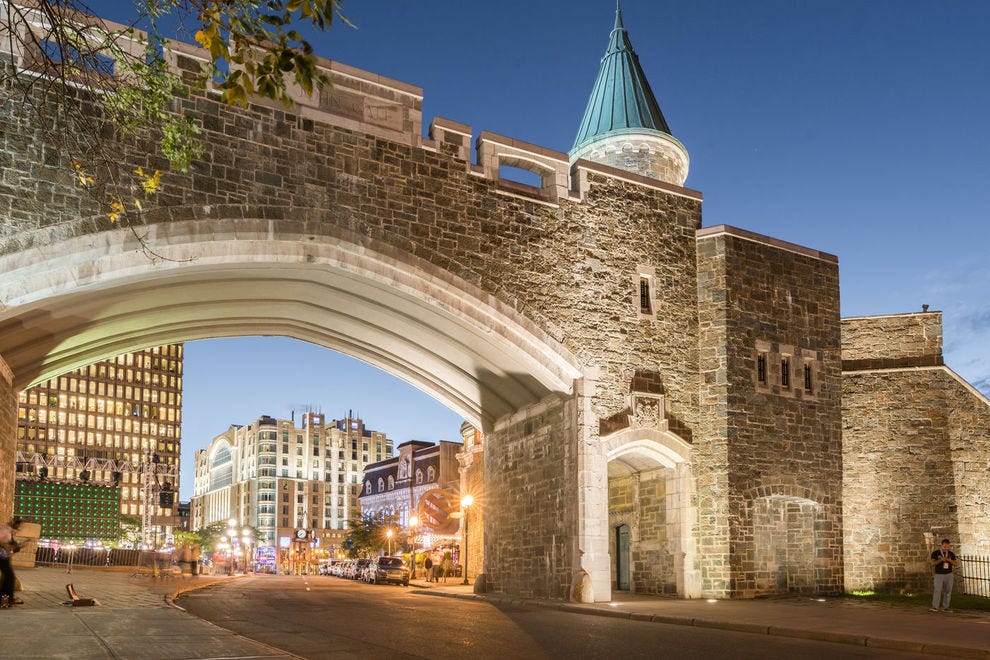

It is a city of outstanding natural beauty, extremely diverse and a centre of dramatic historic events. Being essentially a border town between Canada and United States, the city has played an important role in the expansion of both countries.
Before the arrival of the white settlers, the native inhabitants had lived here for about 800 years. There had been several cultures in the area, including the Iroquois, Algonquian, and eventually the Europeans.
It is estimated that there are over 25,000 years of occupation in the area, enough to prove there is a remarkable amount of life in this area. The Russians and the French settled in the 17th and 18th centuries, followed by the BritishInvasion at the beginning of the 19th century. The British desired a port on the St. Lawrence River they could use to control the passage of goods along the river.
Confederation made it necessary to fortify the city, and on March 30, 1867, Fort Rouille was created. This creation was significant, as it made the city accessible by water. The original fort was destroyed by friendly American troops in 18 perspective years later. What remained at Fort Rouille were offices, bedrooms, a library and the living quarters.
It also became necessary to improve access to the port. Today, a bridge has been constructed to cross to the other side of the St. Lawrence River.
The city has a population of 80,000 people. The main languages are English and French. The highest rate of unemployment is in the public sector, 16% compared to 5% in the private sector. There also exist a number of occupied post- secondary educational institutions. Quebec is a Catholic province, 90% of the province’s population is Protestant, and the House of Quebec is the historical seat of the government.
The bases for tourism are the beaches, the majestic mountain ranges, and the St. Lawrence River. Tourism is developed only in the urban areas, and Quebec has several distinct regions with their own style of tourism.
The worldwide popular TV series True Lies was filmed in the city. The series was also filmed in the old Tip Top Tailor building. The buildings on the island feature a mix of classic Quebec style architecture, and modern skyscrapers.
The island has six tourist regions and is divided by road into six districts. A tourism office is located in every town and borough. These offices are geared towards the tourist trade and offer information on hotels, attractions, restaurants and the general culture of the island.
The island is popular among Quebec skilled artists and photographers, who frequent the island’s gallery and gallery rentals and hold exhibitions. Skilled artists often sell their work in galleries that rent out the elder lodges that are popular on the island.
The diverse landscape is reflected in the different galleries and distinct regions. There are both the rocky beach and the forest regions on the island. The rocky beaches were good for the diving community as the sheer cliffs, north of Sainte-Anne-de-Beau-de-Ré is known as some of the best mining sites in the world.
Much of the island is protected and is quintessentially protected. Five major parks offer protected walking areas and, in the summer, the Ça Roule Endive festival offers one of the best summer festivals in the world.
The island is quintessentially French and is brimming with culture. Montreal’s North West Indian cultures were applied in the island the same way the French applied theirs to Madagascar.
English is taught in all schools and is the language of the province. The radios and highways are mandated to be in both official languages.
The greatest administrative unit of Quebec is the province of Québec. School is provide in all regions of the province. The type of school you attend reflects upon the requirements of the curriculum. There is a French-speaking one and a Quebec French-speaking one. If you prefer both, you must take one or the other. Some of the best schools for both are in the Outaouais region, in the less than 50K population of the province. The Outaouais is one of three regions in the province that are not in the French speaking area (the others are in the Saguenay, Lac-Leamy and Anjou regions). The result is that some children have to be educated in English till age of twelve. The other two bilingual areas are in the Eastern part of the province. The administrative centre of Québec is the city of Quebec. This is also a bilingual university town of just over 50,000 students. Other major cities are Sherbrooke, Mon Quebec, Sainte-Anne-de-Beaupré and Mirabelle.
The dates that shaped the city
Samuel de Champlain landed at the foot of the cliff on July 3, 1608, and built his Habitation where Place Royale stands today: a wooden fort and trading post that became the first permanent French settlement in what is now Canada. The name comes from an Algonquian word for the narrowing of the river, and that narrowing is why the site mattered. Whoever held the cape controlled the St. Lawrence. Within a century the upper town had a bishop, a seminary, convents and a governor’s chateau, and the lower town had the merchants and the docks.
The walls came in stages. The French raised earthworks and the first stone bastions in the early 1700s; the British, who took the city after the Battle of the Plains of Abraham on September 13, 1759, kept building for another century. That battle lasted less than half an hour on the fields just west of the walls, and both commanders, James Wolfe and Louis-Joseph de Montcalm, died of their wounds. The Citadelle, the star-shaped fortress on the highest point of Cap Diamant, was built by the British between 1820 and 1850 and is still an active garrison. In 1985 UNESCO listed the Historic District of Old Quebec as a World Heritage Site, the only fortified city north of Mexico with its walls intact.
Almost all of it can be walked in a morning:
- Place Royale: the site of the Habitation, with Notre-Dame-des-Victoires church (1688) on the square.
- The ramparts: about 4.6 kilometres of wall and the Saint-Louis, Saint-Jean and Kent gates; you can walk along the top.
- Dufferin Terrace: the boardwalk rests on the foundations of the old governors’ forts, visible in the archaeological crypt beneath it.
- The Citadelle: guided tours year-round and the changing of the guard on summer mornings.
- The Plains of Abraham: the battlefield is now a park, with the Plains of Abraham Museum beside the Musee national des beaux-arts du Quebec.
