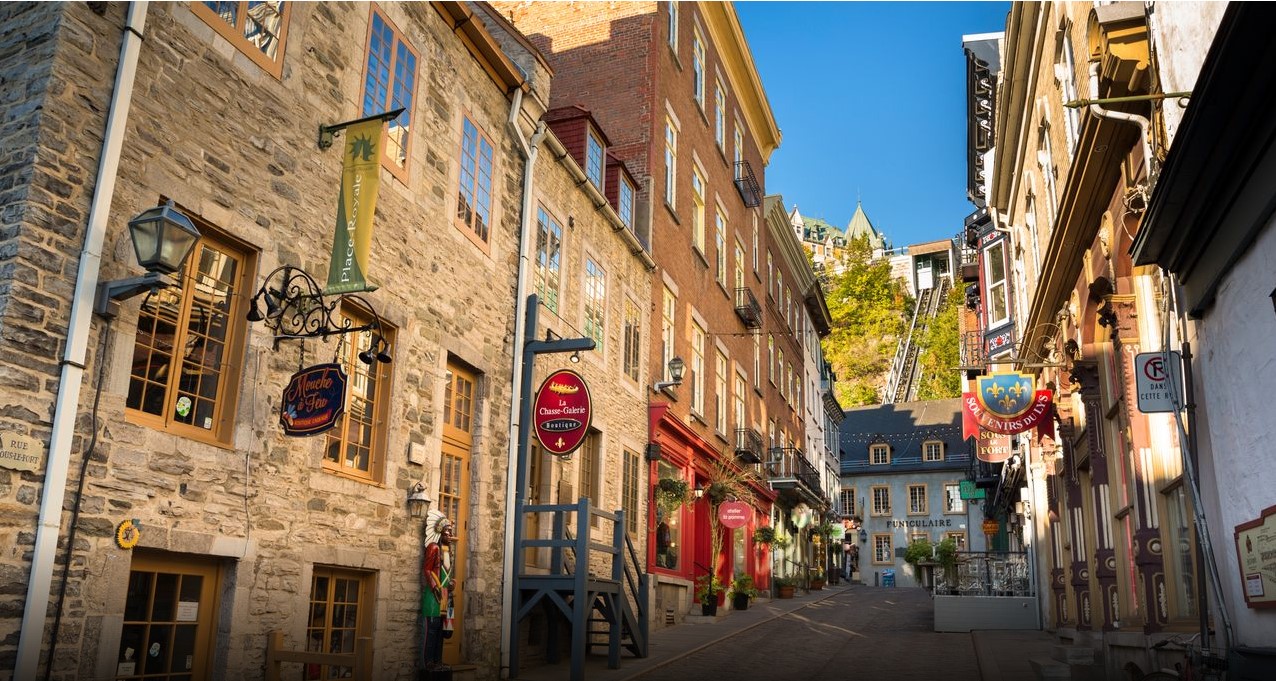

Quebec City is the capital of the province of Quebec and is only accessible via air and sea (hflying form the air port of Mont-Royal).
The area around Quebec City is traversed by the St Lawrence River and extends upwards from the base of the mountains in the region to Mont Royal peak.
Different areas of interests exist in the Quebec City region.
The only railway line in the Quebec City area extends up the side of the mountains and adds to the uniqueness of the city. Apart from these, there is no other road infrastructure to speak of. However, a road building project is underway, and will make the city more pedestrian friendly.
Quebec City is an interesting mixture of both old and new establishments. There are old hotels, old buildings, churches and industrial centres, all located within very tight proximity of each other. The old industrial centres have a distinct character of their own. Some are large, others small, local, national, and international. The only thing separating them on the ground is the years.
So, let’s have a look at what Quebec City, Quebec, has to offer.
There is no shortage of museums and galleries in the city. Their collection is vast and interesting, and they are many. The Musee de la Civilisation is worth viewing due to its many fountains. There are also the Ancient Town Hall and the Basilica of Notre Dame. The latter was built in the excellent style of architect Jacques Marit, who also built Fort Ville-Marie and Fort-de- lang. We’ll be seeing a lot of Quebec City in the future.
It is the contrast of things which interest me most. You go to a historic centre, surrounded by stunning architecture, and just half an hour down the road you have a large, modern city. I love the newness of it all. You can’t help but wonder about the priorities of the politicians which controls the city. It has to be said that I find the old city to be interesting, somewhat disappointing in some ways, but equally fascinating in others. As I said, it has a very distinct character and history. One can only admire the elegance and nobility of the buildings which are hundreds of years old.
If one has a very active and lengthy itinerary, they must visit theProvidence Science Centrebecause it houses the worlds largest espresso machine, holding shots up to the brim. It has also a meteorite sample station,inea rock chondrilite room and a creatureshed. One area of Quebec City boasts a diversity of wildlife in close proximity. The Province of Quebec has recognized the importance of wildlife and has several reserves in their designation. These include the zone of Hardisty, the zone dem Colville, the Mauve Lump benchmarking the Great lakes, the zone demisitasise and the zone national, also within the Great Lakes.
The Province has 11 distinct communitiesonesame with distinct ethnic populations in addition to the original French settlers. Most populations are in the Eastern part of the Province, though there are communities in the South too. The population distribution is as follows:
Most of Quebec’s population is Francophone although English is also spoken. Three quarters of the population are under the age of 35. Atlantic Canada’s population is represented by a largely English speaking population, although there are significant French, Italian and Portuguese speaking groups too. Despite the diversity of the population, Quebec is highly homogeneous, (worth mentioning) and there is a remarkable level of co-oha. Quebecers are known to be extremely friendly and welcoming.
Quebec is a region of outstanding natural beauty, world heritage natural sites and a rich cultural heritage. It is a place that I must visit real soon to see all that it has to offer. It will be a region of outstanding natural beauty, world heritage natural sites, a rich cultural heritage and a friendly and welcoming population.
A season-by-season guide
Winter, December to March, is the season the city built its reputation on. Snow sits on the rooftops of the Old Town, the toboggan run on Dufferin Terrace operates daily, the Carnaval de Quebec fills the first half of February, and the Hotel de Glace stands outside town from January to March. Dress for it and this is the most photogenic version of the city.
Spring, April and May, is the quiet stretch: the snow melts, terraces open cautiously, hotel rates are at their lowest, and the sugar shacks around Ile d’Orleans serve maple-season meals until late April.
Summer, June to August, is the busiest. The Festival d’ete de Quebec brings large outdoor concerts to the Plains in July, the streets of Petit-Champlain and the Old Port stay full until late, and Ile d’Orleans and Montmorency Falls are half an hour away by car or bus. Book lodging well ahead for July.
Fall, mid-September to late October, has the best walking weather. Maple colour peaks around the first two weeks of October in the city and a little earlier in the hills to the north, and crowds thin after the Canadian Thanksgiving weekend.
Two days in Quebec City
Day one, the Old Town. Start at Place Royale and Petit-Champlain in the Lower Town while the shops are still opening, then ride the funicular or climb the Breakneck Stairs to Dufferin Terrace for the view over the river. Walk the ramparts from the Saint-Louis Gate to the Citadelle, have lunch on rue Saint-Jean, and spend the afternoon at the Musee de la Civilisation back in the Lower Town. Finish with a walk along the Old Port at sunset.
Day two, the outskirts. Take a car or the bus to Montmorency Falls, at 83 metres higher than Niagara, and walk the suspension bridge across the top. From there the Ile d’Orleans bridge is a few minutes away; loop the island for farm stands, cider, the old stone church at Saint-Pierre and the view back at the city from Sainte-Petronille. Back in town, eat in Saint-Roch or Limoilou, the neighbourhoods where residents actually go out.
With a third day, choose between the Plains of Abraham and the Musee national des beaux-arts on the west side of the walls, or a half-day at Parc national de la Jacques-Cartier, forty minutes north.
